Introducing GNDX Protocol — The Web3 Gaming Index
An on-chain index for the Web3 gaming sector, built on Arbitrum. One token, curated exposure to the most liquid gaming tokens on Arbitrum One, a 10% weight cap that no governance vote can lift. Here's what we're shipping and why it had to look this way.
Web3 gaming is one of the largest categories in crypto and almost certainly the worst one to invest in directly. Hundreds of tokens, thin liquidity, brutal mortality (we wrote up the numbers here), and a tail of scams that look identical to legitimate projects until they aren't. The investable universe is real — roughly $7B in token market cap today — but almost no individual investor has the time, the data feeds, or the stomach to harvest it.
That gap is what GNDX exists to close. Today we're announcing the protocol publicly and walking through what we're shipping, what we're not, and the order it'll arrive in.
What GNDX is, in one paragraph
GNDX Protocol is a fully decentralised, on-chain index fund for Web3 gaming tokens, deployed on Arbitrum One. You deposit USDC, the protocol mints you $GNDX tokens at the current net asset value of a diversified basket of gaming tokens — 9 at genesis, expanding via governance as the sector grows on Arbitrum. You can redeem $GNDX at any time for either the underlying basket pro-rata or back to USDC. There are no managers, no allowlist, no gates beyond a sanctions check and a US-geofence. The basket composition, the rebalancing rules, and the protocol's parameters are governed by veGAME holders inside hardcoded bounds that even a unanimous vote can't break.
What it isn't
- It isn't a yield-farming vehicle. $GNDX tracks NAV. If the basket's tokens go up, $GNDX goes up. If they go down, it goes down. We're not promising APR.
- It isn't a meme coin. The price is enforced by mint and redeem arbitrage against the underlying basket. There's no narrative-driven premium.
- It isn't a wrapped CeFi product. The vault holds the actual tokens on-chain in an Arbitrum-native contract. You can read the vault balances any time.
- It isn't custody. $GNDX is a transferable ERC-20. Your wallet, your keys, your tokens.
The basket: three tiers, 9 tokens at genesis, 10% cap
The basket is structured into three tiers with target weights set by governance and floor/ceiling bands enforced atomically by the rebalance contract. The genesis basket holds the most liquid gaming tokens available on Arbitrum One today; the Frontier tier is seeded empty and activated by governance as more projects bridge in:
- Core — 65% target (range 55–65%), 7 tokens at genesis. Established gaming tokens with the deepest liquidity and longest track records on Arbitrum One: IMX, AXS, SAND, MANA, GALA, APE, ENJ.
- Ascent — 25% target (range 20–30%), 2 tokens at genesis. Mid-market gaming tokens with active ecosystems and meaningful on-chain liquidity: ILV, MAGIC.
- Frontier — 10% target (range 10–15%), reserved at genesis. Activates via governance vote as emerging Web3 gaming tokens bridge to Arbitrum One and pass the liquidity and oracle thresholds.
The most important number in the protocol isn't a tier weight — it's the per-token cap. No single token can exceed 10% of the basket. That ceiling is hardcoded in the IndexVault contract. A 100-0 governance vote can't move it. A failed proposal that tries to gets reverted at execution, not at vote count. We picked 10% because it's the threshold where, on our historical data, a single-token blow-up still leaves the index recoverable within one quarterly rebalance. We've written about the math behind that choice elsewhere; the short version is that 15% doesn't recover and 5% pays too much in concentration cost.
How you get in and out
Minting is the same shape as a Vanguard ETF, just on-chain:
- Small mints (under $25K): always instant. The protocol absorbs the trivial market impact.
- Mid-size mints ($25K–$50K): probabilistically routed through a TWAP execution; the closer to $50K, the more likely.
- Large mints (above $50K): always TWAP, with chunk count and interval scaled to order size — a $60K mint completes in about 20 minutes, a $1M mint over six hours.
This isn't an arbitrary tier. It's there because routing every mint through TWAP imposes friction nobody wants on small deposits, and routing nothing through TWAP lets a single large deposit move basket prices in ways that hurt every other holder. The brakes are documented in detail in the Phase 5 hardening post.
Redemption is even simpler. There are three modes:
- Redeem for basket: always available, even when oracles are degraded — you get your proportional share of every token in the vault.
- Redeem for USDC: the protocol swaps the basket to USDC for you in one transaction.
- Redeem overweight: if a token has drifted above its target by more than 5%, you can redeem your $GNDX specifically for the overweight token at a small bonus — a self-service rebalance.
The safety surface
Every protocol claims to be safe. The interesting question is what specifically is enforced where. For GNDX:
- Pricing: Chainlink USD feeds where they exist, Uniswap V3 TWAPs with a 20-minute window where they don't. Stale samples (older than 1 hour) revert. Spot prices that diverge from the recent TWAP by more than 30% get clamped, not accepted, with a stability gate that requires three consecutive clean samples before the affected token can re-enter the mint set.
- Pause authority: a 5-of-8 guardian multisig can pause the vault for up to 72 hours. That's all it can do — no fund movement, no parameter change, no ability to extend its own pause.
- Governance bounds: the streaming fee can range from 25 to 150 bps, redeem fee from 10 to 50 bps, lock multipliers across five fixed durations. Anything outside the bounds reverts at execution, not at vote count.
- Upgrade path: contract upgrades go through a 7-day timelock. Standard parameter changes go through 48 hours. There is no shortcut.
Two tokens, two jobs
$GNDX is the index product. Elastic supply, minted on USDC deposit, burned on redemption. Tracks the basket. Not staked. Not used for governance. Just the index.
$GAME is the governance token. Fixed supply of 200,000,000, all minted to treasury at deployment. The mint function does not exist after that. Lock $GAME as veGAME to earn a share of protocol fee revenue and vote on what's in the basket, what fees are charged, and how revenue is allocated. Five lock durations (3 months to 4 years) with corresponding multipliers, linear decay to zero. We've written a plain-language guide if you want the mechanics.
Fees and where they go
Three fees, two beneficiaries:
- Mint fee — 10 bps default, capped at 25 bps. Paid in USDC at the time of mint.
- Redeem fee — 20 bps default, range 10–50 bps. Paid in $GNDX at the time of redemption.
- Streaming fee — 75 bps annual default, range 25–150 bps. Accrues continuously against the vault.
For comparison: Vanguard index funds run roughly 20 bps; Bitwise and Galaxy crypto index products run 150–250 bps. Our streaming fee sits closer to the TradFi end because that's the rational floor — there's a real cost to running oracles, executing rebalances, and maintaining adapters across DEXes. Anything materially lower would force a subsidy or a corner-cut we're not willing to make.
Revenue flows weekly into a single USDC pool, gets converted to $GAME, and then splits between veGAME stakers and a $GAME burn. The mechanics are deterministic and publicly verifiable — no treasury discretion.
Launch roadmap
- Phase 0 (complete): Protocol foundation — 19 implementation contracts, 718+ unit tests, ≥95% line coverage.
- Phase 1 (in progress): Independent audits, fork-based integration tests, and public competitive review.
- Phase 2 (post-audit): Mainnet deployment on Arbitrum One. Initial basket goes live with the launch composition. Genesis NAV = $1.00.
- 90 days post-mainnet: First quarterly rebalance vote.
What to do today
If you want exposure to Web3 gaming without picking individual tokens, the answer at mainnet will be: deposit USDC at gndx.finance, receive $GNDX. Until then, the things that matter are reading the litepaper if you want the full architecture, watching the roadmap for launch progress, and joining the Discord if you want to ask questions of the team and other holders.
We've spent eighteen months getting the safety surface right because the moment a sector index ships, the only thing that matters is whether it survives the first stress event. Everything else is downstream of that. We'll see you at mainnet.
More posts
All articlesThe Seeding Window: How GNDX Onboards New Tokens
When governance approves a new token for the basket, it doesn't appear fully-allocated overnight. A bounded 14-day seeding window funds it in measured chunks, suppresses alarm noise, and keeps redemption fair while the basket transitions. Here's the mechanic and why it works the same at $1M, $100M, or $1B TVL.
Mint, Burn, NAV: How GNDX Pricing Actually Works
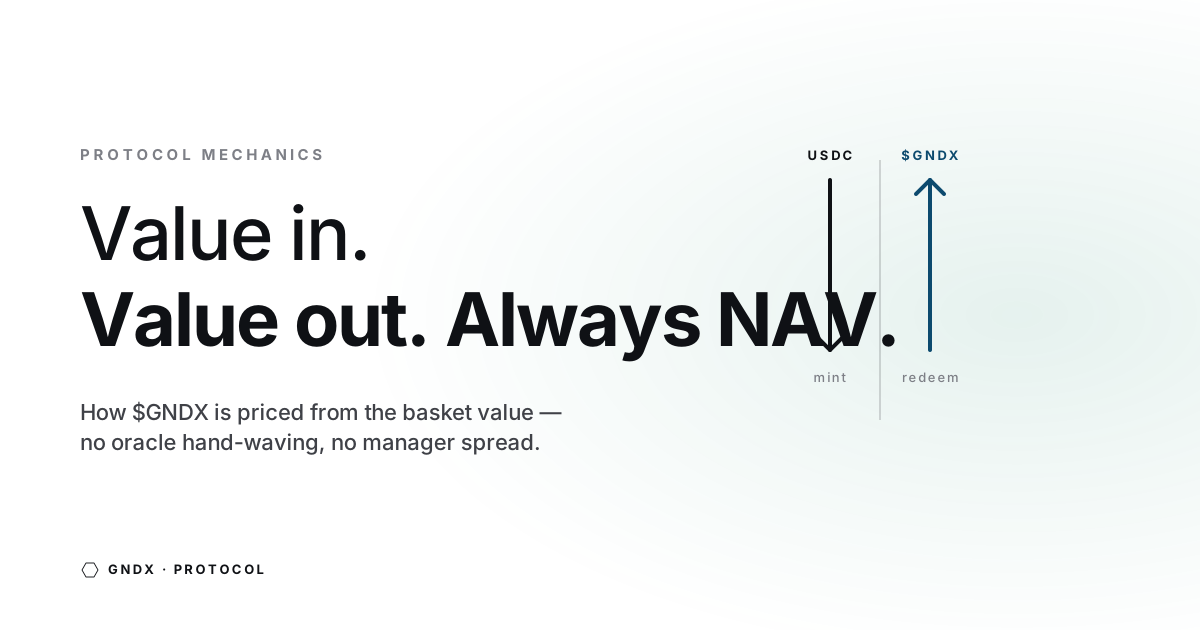
Most DeFi tokens move on sentiment. An index moves on math. This is the plain-language version of how a $GNDX token gets priced, what happens when you mint or redeem, and why the price can't drift away from the basket.
Why 10%? The Math Behind GNDX's Hardcoded Weight Ceiling
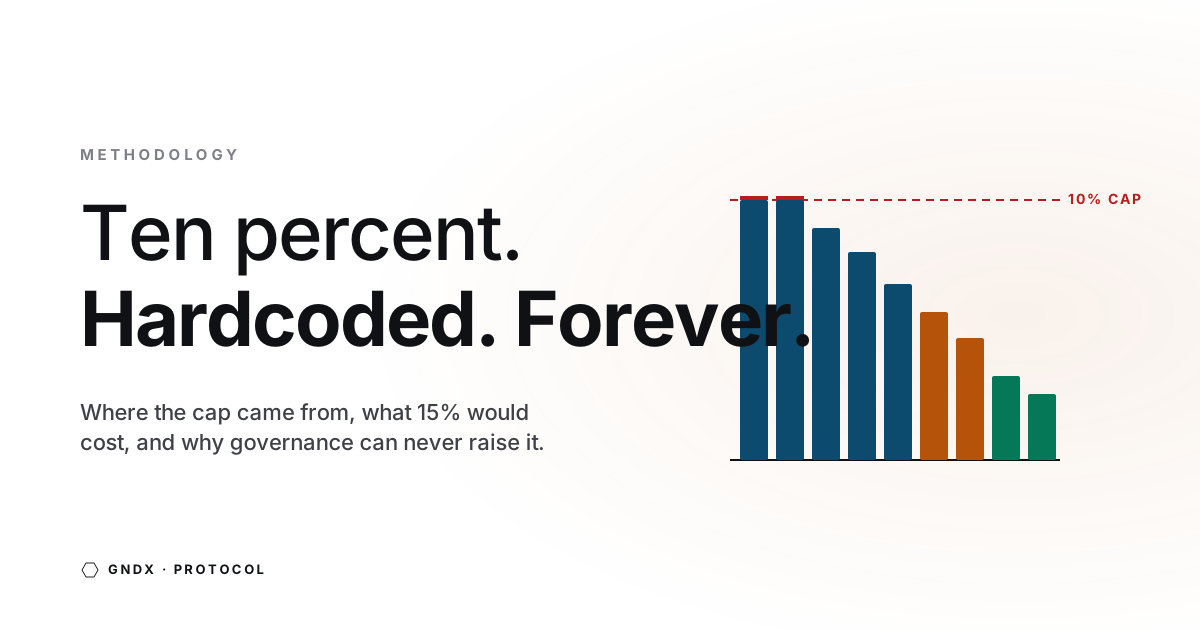
The most consequential number in the protocol is also the one that looks the most arbitrary. We modeled blow-up scenarios from 5% to 25% caps to figure out where the real cliff is — and why the answer had to be in code, not in a vote.